Putin’s Two-Day Visit to China: A Message to Washington and Its Allies

A Timed Diplomatic Visit :

Russian President Vladimir Putin arrived in Beijing this week for a high-profile two-day state visit hosted by Chinese President Xi Jinping, in what has quickly become one of the most closely watched geopolitical meetings of 2026. The visit came only days after U.S. President Donald Trump’s own trip to China, giving Beijing an unusual diplomatic position: hosting both Washington and Moscow within the same week. Analysts widely viewed the timing as deliberate symbolism a demonstration that China now sees itself not merely as a participant in global diplomacy, but as a central power capable of balancing relations with both rivals and partners simultaneously.

Putin arrived in Beijing late on May 19, where he was personally received by Chinese Foreign Minister Wang Yi. A gesture widely viewed as a sign of the importance Beijing attached to the visit. The Russian delegation accompanying Putin included senior ministers, deputy prime ministers, business executives, and regional governors, underlining the broad economic and strategic scope of the meetings.

The following morning, Xi Jinping hosted Putin at the Great Hall of the People in an elaborate state welcome ceremony. The two leaders inspected troops of the People’s Liberation Army, listened to the national anthems of both countries, and later held both restricted and extended bilateral talks.

Symbolism and Diplomatic Messaging

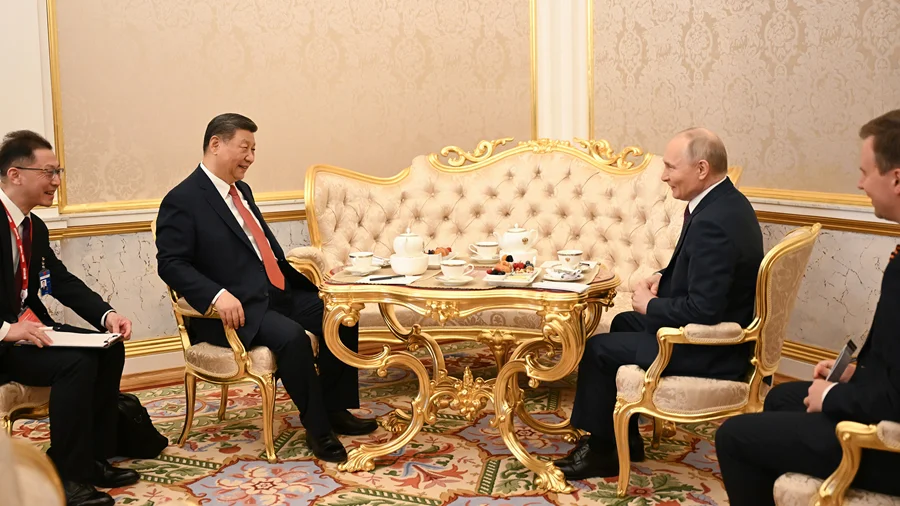
The symbolism throughout the visit appeared carefully designed. Beyond formal meetings, both leaders attended a tea session and visited a photo exhibition dedicated to the historical friendship between the two countries, imagery that reinforced the narrative of long-term political trust and strategic continuity between Beijing and Moscow.

During the meetings, China and Russia agreed to extend the 2001 Sino-Russian Treaty of Friendship, while also signing nearly two dozen agreements covering trade, education, strategic coordination, and multilateral cooperation. Putin repeatedly referred to Xi as his “dear friend,” while Xi emphasized that China-Russia relations had entered “a new stage” of development and cooperation.

The summit was not simply about bilateral diplomacy. It also carried a broader political message directed toward Washington and its allies: that attempts to isolate Russia internationally have not succeeded, and that China remains unwilling to fully align itself with Western geopolitical pressure campaigns.

The Pipeline Issue at the Center of Discussions

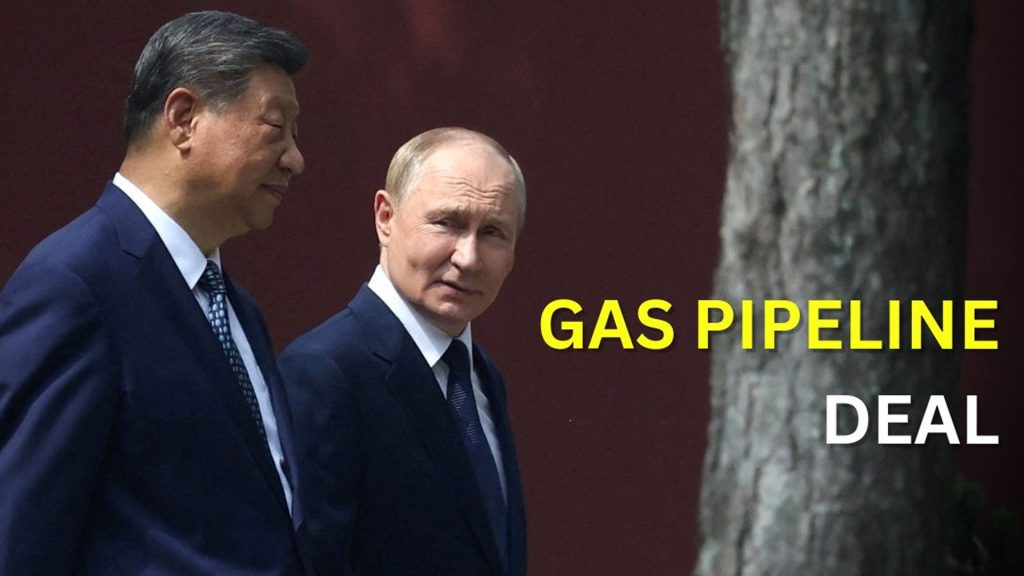
One of the most closely watched aspects of the visit was the long-discussed “Power of Siberia 2” gas pipeline project. A proposed energy corridor that would redirect large volumes of Russian natural gas toward China following Moscow’s sharp decline in energy exports to Europe after Western sanctions.

For Russia, the project is economically critical. Since the war in Ukraine and the deterioration of ties with Europe, Moscow has increasingly relied on Asian markets, particularly China, to offset economic pressure from the West. A finalized pipeline agreement would further deepen long-term energy cooperation between the two countries while reducing Russia’s dependence on European buyers.

However, despite expectations surrounding the summit, no final agreement on the pipeline was announced. Reports suggest that pricing structures, financing mechanisms, and long-term supply terms remain unresolved. The absence of a completed deal highlighted an increasingly visible reality within the China-Russia relationship: while both countries continue strengthening strategic ties, Beijing currently negotiates from a position of greater leverage.

China benefits from discounted Russian energy exports and expanded trade opportunities, while Russia increasingly depends on Chinese markets, technology, and economic support. Several international analysts noted that Beijing’s approach appears highly calculated/supportive enough to strengthen Russia strategically, but cautious enough to avoid exposing China to direct geopolitical or sanctions-related risks.
A Shared Narrative Against Western Dominance

The political messaging from the summit was direct but carefully framed. In joint statements and public remarks, both leaders criticized what they described as unilateral foreign policy approaches, military interventionism, and growing instability within the international system.

Xi Jinping stated that the current global situation is marked by “intertwined turmoil and change,” while warning against what he described as increasing unilateralism and hegemonic thinking. Both governments once again promoted the idea of a “multipolar world order”. A concept frequently used by Beijing and Moscow to advocate for a global system less dominated by the United States and its Western allies.

During the talks, both sides also criticized aspects of U.S. strategic defense policy, including Washington’s missile defense initiatives and the expected expiration of the New START nuclear arms treaty framework. The discussion reflected broader concerns in both Beijing and Moscow regarding long-term global security architecture and strategic military balance.

The rhetoric from both leaders reinforced a narrative that China and Russia increasingly see themselves as strategic partners resisting Western political and economic influence, while simultaneously attempting to reshape global power structures in favor of a more distributed international order.

Journalist and Analyst Perspectives

International journalists and geopolitical analysts interpreted the summit through several different lenses. Some viewed the visit as a clear signal of deepening anti-Western alignment between Beijing and Moscow amid continuing tensions involving Ukraine, NATO, and global security competition.

Others argued that the summit revealed an important imbalance within the partnership itself. While Russia continues seeking political and economic support, China increasingly holds the stronger negotiating position due to its economic power, global trade influence, and relative geopolitical flexibility.

Several commentators also focused on Xi Jinping’s broader diplomatic positioning. By hosting both Trump and Putin within days of each other, Xi reinforced China’s image as a state capable of engaging all major powers simultaneously while remaining central to global negotiations and strategic discussions.

According to multiple international observers, Beijing appears increasingly determined to present itself as a stabilizing global actor at a time when international politics is becoming more fragmented and competitive.

Western Reactions and Strategic Concerns

Western governments followed the summit closely. American officials remain concerned about growing China-Russia coordination in areas including energy, industrial trade, technology, financial systems, and strategic cooperation outside Western-led institutions.

NATO members and several European governments increasingly view the expanding partnership between Moscow and Beijing as a long-term geopolitical challenge to the existing Western-led international order. However, analysts also noted the limitations of the relationship.

No formal military alliance emerged from the visit, no major breakthrough occurred regarding Ukraine peace efforts, and the crucial pipeline agreement remained incomplete. Those realities suggest that while China and Russia are strategically aligned on many issues, their partnership still contains differing priorities and careful political calculation on both sides.

Immediate Outcomes of the Visit

In immediate terms, the visit delivered symbolic victories for both governments. Putin demonstrated that Russia remains far from internationally isolated despite years of sanctions and diplomatic pressure from the West. Xi Jinping, meanwhile, reinforced China’s position as a major global power capable of balancing relationships across competing geopolitical blocs.

At the same time, the summit also revealed the evolving nature of the China-Russia partnership as one increasingly shaped by economic pragmatism, strategic coordination, and shifting global power dynamics rather than purely ideological alignment.

Leave a Reply

Your email address will not be published. Required fields are marked *